
¿Cómo funciona un dispositivo anticolisión? Una guía práctica para clínicas, escuelas y distribuidores.


Autor
Experimente la diferencia de Xiamen Tianzuo Medical, donde cada producto es un testimonio de nuestra dedicación a la salud y la seguridad.
Marie R. Winters


Resumen: La asfixia es una de las principales causas de muerte por lesiones accidentales; sin embargo, la maniobra de Heimlich estándar no es segura ni eficaz para todos, incluidos bebés, ancianos, mujeres embarazadas y personas en silla de ruedas. Un dispositivo anti-asfixia (también llamado dispositivo de rescate o de succión) ofrece una alternativa no invasiva que utiliza presión negativa para eliminar la obstrucción. Esta guía explica su funcionamiento paso a paso, cómo se compara con las compresiones abdominales, quién debería tenerlo disponible y qué deben verificar los distribuidores antes de adquirirlo.
¿Por qué los dispositivos de rescate para casos de asfixia están ganando popularidad?
En Estados Unidos, el atragantamiento es la cuarta causa principal de muerte por lesiones no intencionadas, y en bebés menores de un año es la principal causa de muerte por lesiones prevenibles. La maniobra de Heimlich ha salvado innumerables vidas desde 1974, pero depende de la fuerza del rescatador y de la técnica correcta, y puede causar fracturas de costillas o lesiones internas en pacientes frágiles. Esta limitación explica por qué las escuelas, residencias de ancianos y restaurantes están incorporando dispositivos de rescate por succión a sus botiquines de primeros auxilios, y por qué varios estados de EE. UU. han comenzado a exigirlos en los centros educativos.
Cómo funciona un dispositivo antiahogo
El principio es simple: en lugar de empujar el aire hacia adentro (como en las compresiones abdominales), el dispositivo extrae la obstrucción mediante succión. Una unidad típica —nuestro dispositivo de succión para obstrucciones TW8648 sigue este diseño— tiene cuatro partes:
- Mascarilla: Se coloca sobre la nariz y la boca para formar un sello hermético.
- Válvula unidireccional: Impide que el aire sea empujado más adentro de las vías respiratorias.
- Bomba de émbolo/succión: Presione para purgar el aire y luego tire hacia atrás para generar presión negativa.
- Tubo transparente: Permite que el rescatador vea el objeto desprendido.
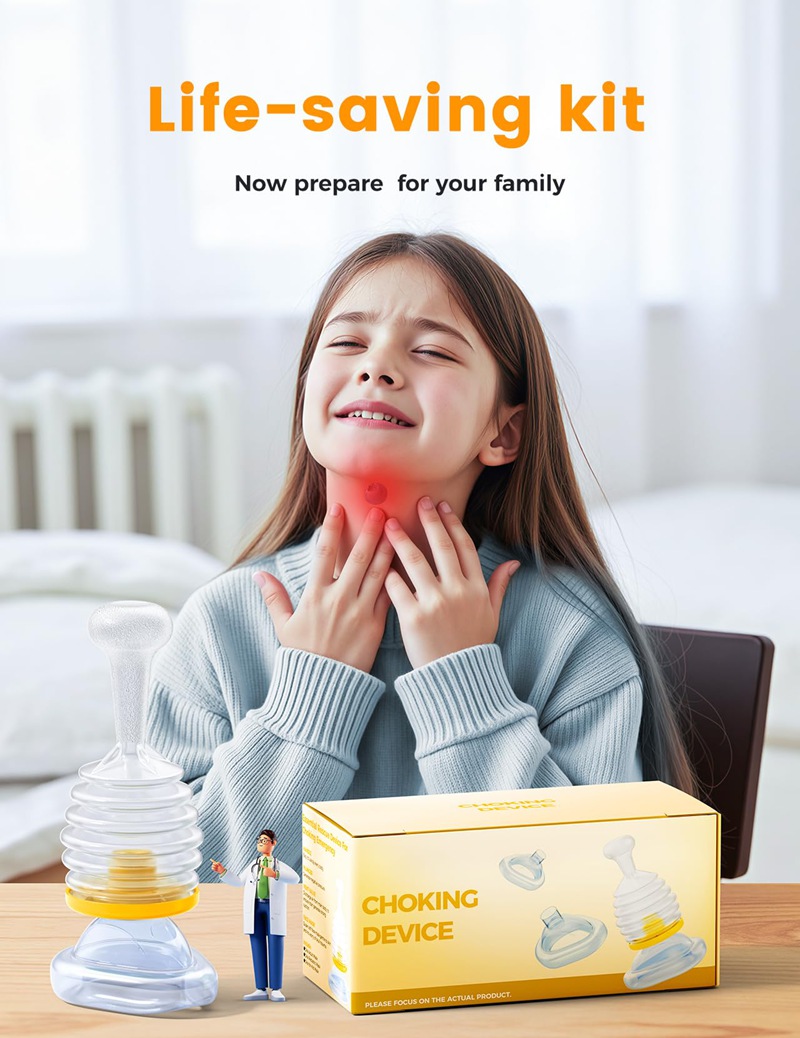
Para usarla, colóquese la mascarilla, presione el émbolo hacia abajo para expulsar el aire y luego tire de él hacia arriba para crear succión. Si el primer intento no elimina la obstrucción, repita el movimiento de empujar y tirar sin quitarse la mascarilla. La mayoría de los usuarios sin conocimientos médicos pueden armar y usar el dispositivo en aproximadamente tres minutos, dentro del tiempo límite antes de que la hipoxia cause daño.
Dispositivo antiahogo frente a la maniobra de Heimlich
No son rivales; son capas de defensa. Las directrices siguen priorizando los golpes y las compresiones abdominales. El dispositivo es la opción de *segunda línea* cuando estas fallan o cuando el rescatador no puede aplicarlas de forma segura; por ejemplo, en el caso de una mujer embarazada, una persona mayor frágil con osteoporosis o un bebé cuyas costillas son demasiado delicadas para las compresiones. Dado que la succión es más suave que las compresiones, también es más fácil para un transeúnte sin entrenamiento intentarlo sin causar lesiones.
Una advertencia que los distribuidores deben comunicar: estos dispositivos deben complementar, no reemplazar, la capacitación estándar en primeros auxilios. Los compradores deben tenerlos a mano junto con la capacitación en RCP y en casos de asfixia, no en lugar de ella.
¿Quién debería comprar uno?
- Escuelas y guarderías: Donde los niños pequeños se atragantan con mayor frecuencia.
- Residencias de ancianos y centros de cuidados: Para residentes que no toleran las compresiones abdominales.
- Restaurantes y gimnasios: Entornos públicos de alto riesgo con aglomeraciones de personas de edades mixtas.
- Kits para el hogar y los viajes: Especialmente para familias con bebés o parientes ancianos.
- Clínicas y ambulancias: Como respaldo documentado en el algoritmo de vía aérea.
Qué buscar al adquirir un dispositivo antiahogo
Si eres distribuidor o responsable de compras y estás evaluando proveedores, ten en cuenta estos puntos:
- Válvula unidireccional transparente y sello hermético para la mascarilla — el núcleo de una operación segura.
- Cámara transparente para que los rescatadores vean el objeto extraído.
- Opciones de mascarillas para adultos y niños en un solo kit siempre que sea posible.
- Instrucciones sencillas basadas en pictogramas Para usuarios no capacitados.
- Certificaciones y control de calidad — trabajar con un fabricante que utilice procesos ISO 13485 y que pueda proporcionar la documentación de prueba.
Productos relacionados
¿Por qué asociarse con Tianzuo Medical?
Como fabricante verticalmente integrado de productos de emergencia, anestesia y respiración, Xiamen Tianzuo Medical aplica el mismo sistema de calidad a los dispositivos para vías respiratorias que a nuestros reanimadores insignia: producción certificada según la norma ISO 13485:2016, con la marca CE y homologada por la FDA, además de moldeo propio y soporte OEM/ODM. Para mayoristas y propietarios de marcas, ofrecemos etiquetado privado, cantidades mínimas de pedido flexibles y la documentación necesaria para licitaciones y cumplimiento normativo en el sector minorista.
Si está agregando dispositivos de rescate para casos de asfixia a su catálogo, Ponte en contacto con nuestro equipo. Para obtener información sobre precios, muestras y opciones de personalización, envíe un correo electrónico a Stephen@tzmed.com.
Preguntas frecuentes
¿Cómo elimina un dispositivo antiahogo una obstrucción?
¿Puede sustituir la maniobra de Heimlich?
¿Es seguro un dispositivo antiahogo para bebés?
¿Es necesario recibir formación para utilizar estos dispositivos?
¿Puede Tianzuo Medical suministrar dispositivos antiahogo bajo nuestra marca?
- Cómo usar un espirómetro de tres bolas: una guía práctica para la recuperación respiratoria después de una cirugía.
- Cómo elegir un inmovilizador de cabeza: Guía de compra B2B para servicios de emergencias médicas y hospitales.
- Cánula nasal de alto flujo (HFNC): cómo funciona y cuándo elegirla en lugar de una mascarilla de oxígeno estándar.
- Cánula nasal de oxígeno: La herramienta fundamental y silenciosa de la oxigenoterapia (y cómo elegir la adecuada)
- Férula neumática vs. escayola: ¿Qué dispositivo de inmovilización debería elegir?
- Mascarilla Venturi frente a mascarilla sin reinhalación: ¿Qué dispositivo de suministro de oxígeno debería elegir?
- Mascarilla laríngea (LMA) frente a tubo endotraqueal: cómo elegir la vía aérea adecuada.
- Cómo elegir una mascarilla CPAP: Facial completa vs. Nasal vs. Almohadilla nasal (Guía del comprador 2026)